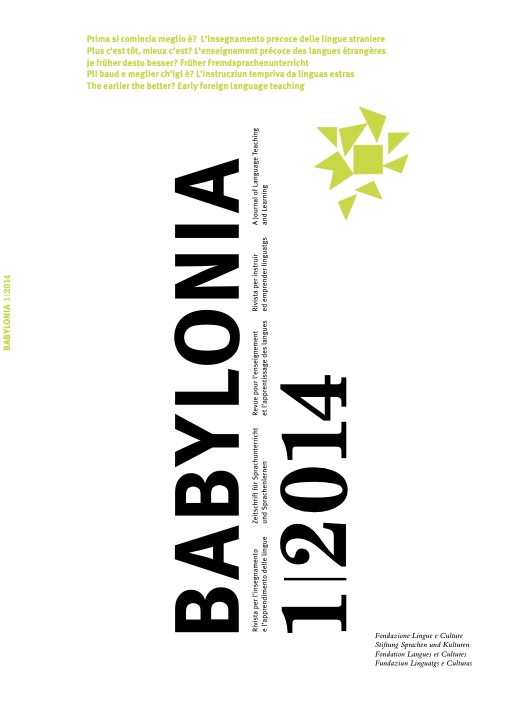
The earlier the better ? Early foreign language teaching
DOI:
https://doi.org/10.55393/babylonia.vi1.579Keywords:
PDF, 1_2014Abstract
[Summary generated by Poe]
The issue explores the theme of early foreign language teaching and its implications in various contexts, particularly in Switzerland. It highlights the growing interest in multilingualism and the importance of effective language teaching strategies.
-
Early Language Instruction: The introduction emphasizes that starting foreign language learning at an early age is generally seen as beneficial. However, it questions the assumption that early exposure guarantees better language proficiency. While young learners may have cognitive advantages, the quality and quantity of language exposure are crucial factors influencing success.
-
Diverse Perspectives: Contributions from various experts present different viewpoints on early language teaching. Some argue for the cognitive and social benefits of multilingualism, while others express skepticism about its effectiveness. The discourse reflects the tension between educational policies and scientific research, particularly in relation to the Critical Period Hypothesis, which suggests that language acquisition is easier at a younger age.
-
Practical Implications: Articles discuss practical aspects of language teaching, including the need for high-quality input and engaging activities that foster interaction among students. Peer-to-peer communication is highlighted as a vital opportunity for language practice, supporting the development of communicative competence.
-
Case Studies and Research: Specific case studies, such as the bilingual education initiatives in Biel/Bienne, illustrate how immersion programs can enhance language learning. Evaluations of new teaching materials show positive acceptance among teachers, yet raise concerns about the adequacy of support for diverse learners.
-
Challenges and Recommendations: The issue addresses challenges such as the need for effective teacher training, the importance of recognizing linguistic diversity in classrooms, and the necessity of adapting teaching methods to meet the needs of all students. It calls for a balance between structured learning and the natural, immersive experiences that promote language acquisition.
-
Cultural and Social Context: The context of language learning is also examined, particularly in relation to minority languages in Switzerland. Discussions reveal the complexities of integrating different linguistic communities and the need for inclusive strategies that honor all languages and cultural identities.
Overall, the issue of Babylonia 1/2014 provides a comprehensive overview of the current state of early foreign language teaching, emphasizing the significance of quality instruction, the role of social interaction, and the necessity for ongoing research and adaptation in educational practices.
Downloads
Published
How to Cite
Issue
Section