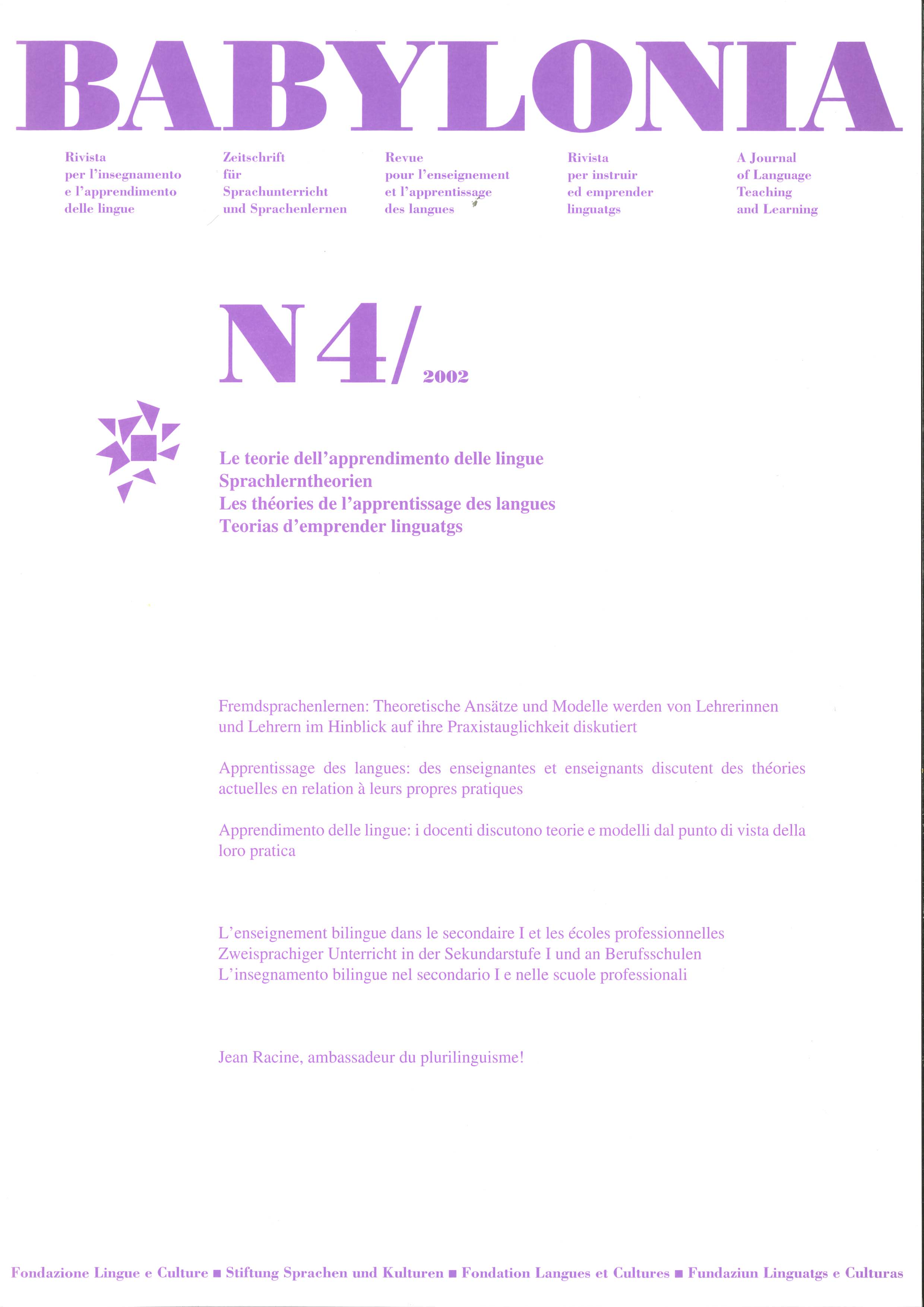
Theories of language learning
DOI:
https://doi.org/10.55393/babylonia.v4i.610Keywords:
PDF, 4_2002Abstract
[Summary generated by Poe]
Editorial Overview
The fourth issue of Babylonia in 2002 delves into language learning theories against a backdrop of global uncertainties. It emphasizes the need for diverse theoretical frameworks to help educators adapt to evolving perceptions of language instruction.
Language Learning Theories
Key contributions focus on various aspects of language acquisition:
- Dieter Wolff presents language learning as a constructive process, highlighting the importance of learner autonomy and the role of teachers as facilitators rather than mere instructors.
- Ineke van de Craats examines the impact of the mother tongue on second language acquisition, discussing three models: Contrastive Analysis, Interlanguage Hypothesis, and Creative Construction Hypothesis, emphasizing how native language influences learning strategies and errors.
- Simona Pekarek Doehler stresses the significance of social interaction in language acquisition, proposing that effective learning occurs in social contexts where cognitive and linguistic skills are developed collaboratively.
Practical Applications
The issue also explores practical implications for language teaching:
- Torsten Schlak critiques the Teachability Hypothesis, which asserts that instruction must align with learners’ developmental stages. He discusses the importance of timing and readiness for effective grammar teaching, arguing that not all linguistic structures can be taught at all times.
- David Golay advocates for bilingual subject teaching in Swiss vocational schools, arguing that integrating language learning with subject content can enhance competencies without overwhelming students.
Bilingual Education Initiatives
Various bilingual education projects in Switzerland are highlighted:
- Willy Nabholz addresses the challenges and benefits of implementing a second language curriculum in vocational education, emphasizing structured language instruction to maintain students' prior knowledge.
- Esther Jansen O’Dwyer outlines the design and implementation of bilingual teaching methods in vocational schools, stressing the importance of adapting strategies to meet diverse learner needs.
Research and Data
The issue references empirical studies showing that bilingual education can lead to equal or improved subject knowledge compared to traditional instruction. These findings suggest that with appropriate support, learners can effectively navigate the challenges of bilingual environments.
Conclusion
Babylonia 4/02 serves as a comprehensive exploration of language acquisition theories and their practical implications for educators. It advocates for a collaborative, interactive approach to learning that acknowledges the complexities of language and culture, arguing for a nuanced understanding of how learners acquire languages and how educational practices can evolve to better support this process.
Downloads
Published
How to Cite
Issue
Section