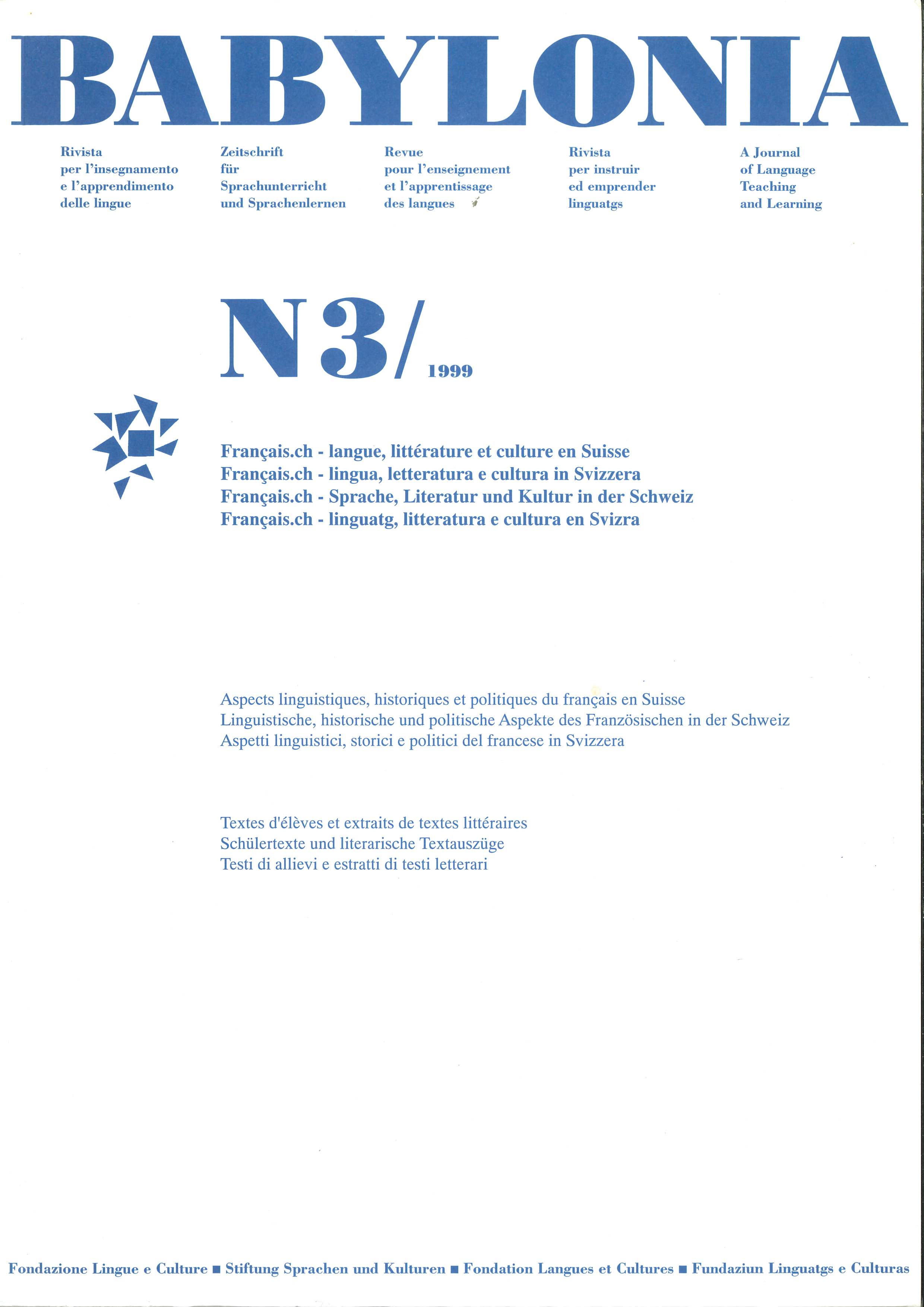
Français.ch - language, literature and culture in Switzerland
DOI:
https://doi.org/10.55393/babylonia.v3i.624Keywords:
PDF, 3/1999Abstract
[Summary generated by ChatGPT]
Overview:
This issue of Babylonia focuses on the French language and its cultural and literary presence in Switzerland. As part of a series on national and migrant languages in Switzerland, it examines Swiss French as a regional variety, exploring its historical, sociolinguistic, and educational implications.
Key Contributions:
Editorial Insights:
The editorial critiques the lack of concrete action following Swiss federal recommendations to improve interlinguistic understanding. It highlights the urgency of valuing linguistic diversity through active cultural and educational policy, especially for minority language communities.
History and Identity:
Andres Kristol traces the linguistic history of Romandie, from its Latin roots through the decline of local dialects (francoprovençal and jurassien). He emphasizes how Swiss French emerged as a written language first, influenced by French central norms but shaped by regional usage.
French in Contact:
Several articles explore Swiss French as a language in contact—with German and former local dialects. The unique vocabulary, syntax, and pronunciation of Swiss French are discussed, especially as captured in the Dictionnaire suisse romand.
Cultural Perceptions:
Pascal Singy and others examine how Swiss French speakers perceive their language—often marked by linguistic insecurity due to comparison with Parisian norms. There's a recurring theme of tension between regional identity and external linguistic standards.
Literature and Regional Voice:
Contributions from authors and educators showcase Swiss French literature and its role in expressing regional identity. Excerpts from works by Romand writers like S. Corinna Bille reflect the richness of this literary tradition.
Education and Language Teaching:
Several pieces debate how to teach Swiss French in schools—as a native language (L1) and as a second language (L2). The issue argues for greater inclusion of regional variations in curricula and for the acknowledgment of local language features in pedagogy.
Conclusion:
The issue calls for a pluralistic view of French in Switzerland—one that embraces linguistic variation, recognizes regional identity, and supports educational practices grounded in cultural awareness. It also underscores the need for political will to sustain multilingualism in Switzerland.
Downloads
Published
How to Cite
Issue
Section