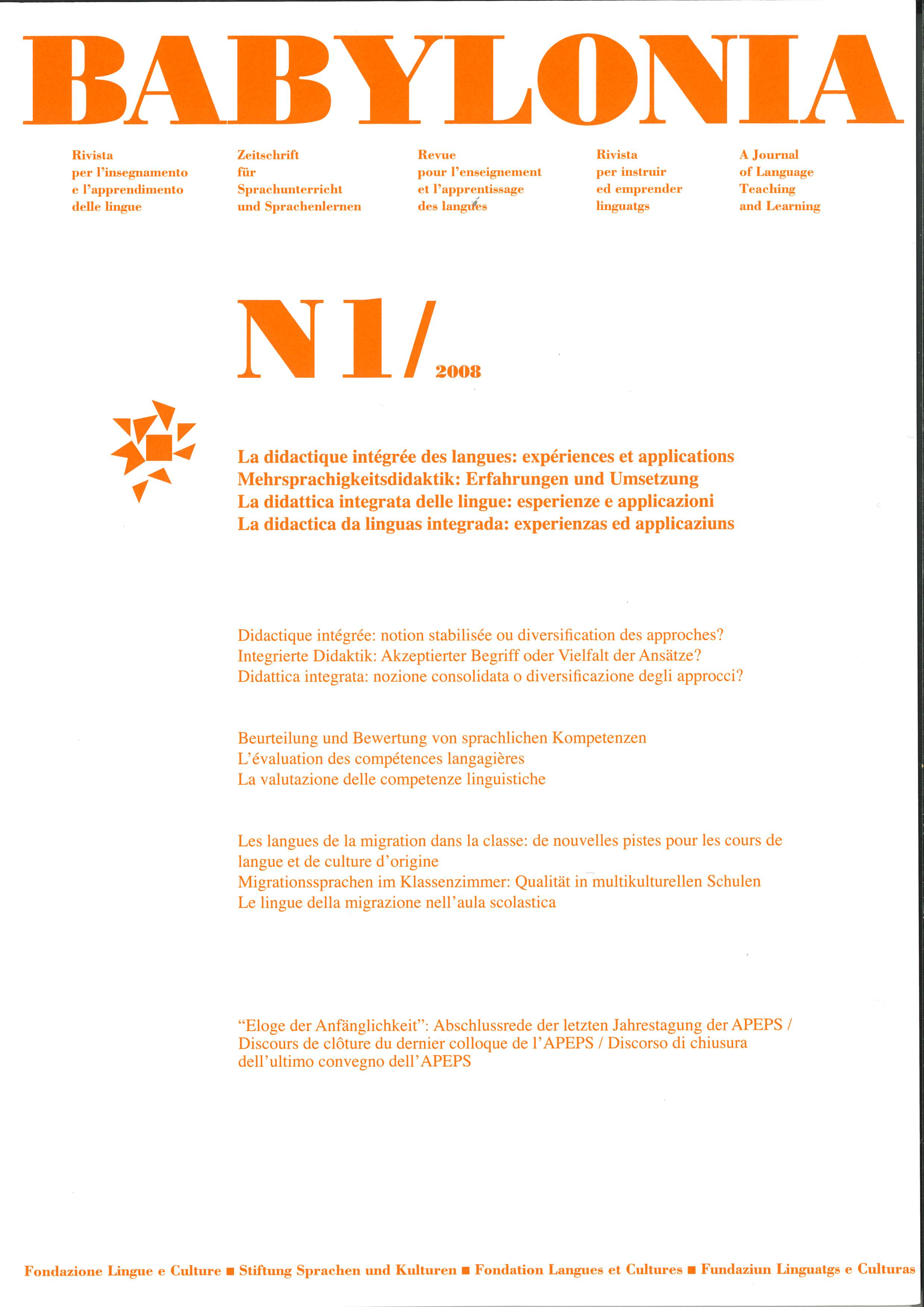
Integrated language teaching: experiences and applications
DOI:
https://doi.org/10.55393/babylonia.v1i.646Keywords:
PDF, 1_2008Abstract
[Summary generated by Poe]
This issue of Babylonia focuses on integrated language didactics, exploring experiences and applications in multilingual education across various regions and educational contexts in Switzerland.
- Editorial Overview: The editorial emphasizes the evolving role of sports in international events, questioning whether they have always been purely athletic or inherently political, as exemplified by historical Olympic games.
- Main Theme: The central theme discusses the integrated teaching of languages, highlighting the importance of multilingualism in education. Contributions from various authors detail the evolution of language didactics, the impact of school contributions to students' plurilingual competencies, and the implementation of integrated approaches in teaching (e.g., English and German in primary education).
- Contributions:
- Claudine Brohy examines the evolution of integrated language didactics, emphasizing its relevance in today’s educational landscape.
- Susanne Wokusch discusses how schools can enhance students' multilingual abilities, proposing coordinated curricula that integrate different languages.
- Marisa Cavalli presents methods for teaching English in primary schools and the challenges of integrating it with existing curricula.
- Other contributions explore the significance of students' first languages in multilingual classrooms and the necessity of considering cultural identities in language teaching.
This edition of Babylonia serves as a comprehensive resource for educators, providing insights into the challenges and opportunities within the field of language education in a multilingual context.
Downloads
Published
2008-04-04
How to Cite
Integrated language teaching: experiences and applications. (2008). Babylonia Journal of Language Education, 1. https://doi.org/10.55393/babylonia.v1i.646
Issue
Section
Full issue