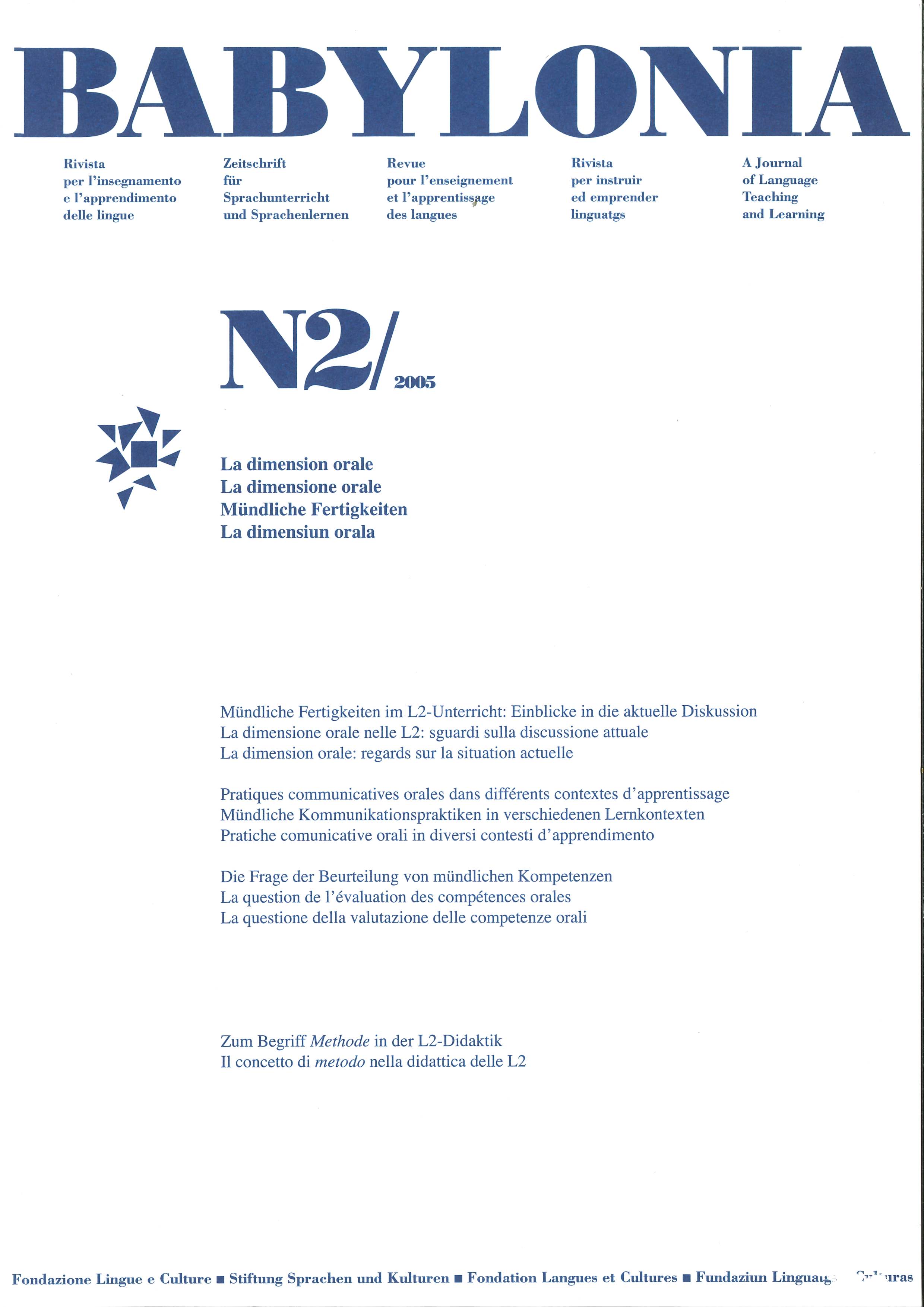
Oral skills
DOI:
https://doi.org/10.55393/babylonia.v2i.669Keywords:
PDF, 2/2005Abstract
[Summary generated by ChatGPT]
Overview:
This issue of Babylonia is devoted to oral skills in second language (L2) learning and teaching, a key yet often overlooked dimension in language education. Through theoretical reflections and practical experiences, the journal highlights how speaking is central not only to language development, but also to learner identity, motivation, and cultural integration.
Key Contributions:
The editorial outlines political tensions around language education in Switzerland while emphasizing the pedagogical importance of orality. Claude Germain and Joan Netten argue that oral competence forms the foundation of literacy in L2, requiring implicit, procedural learning through use, not explicit grammar rules.
Marie-Françoise Chanfrault-Duchet proposes a cognitive-linguistic model rooted in the “lexical approach,” emphasizing the memorization of pre-constructed chunks for greater fluency. Several authors describe innovative classroom practices: role-play, improvisation, bilingual education, and assessments aligned with the CEFR.
Brian North and Erwin Tschirner address oral assessment frameworks, while Giovanni Mascetti and Irène Schwob examine student perceptions and the pedagogical potential of oral exams. Other contributions touch on genre-based approaches, early immersion, and the socio-political dimension of oral interaction.
Conclusion:
This issue presents oral language skills as essential to meaningful L2 acquisition. It calls for teaching approaches that balance fluency and accuracy, promote interaction, and recognize learners’ voices. Babylonia urges renewed attention to orality as both a pedagogical goal and a foundation for social and linguistic competence.
Downloads
Published
How to Cite
Issue
Section