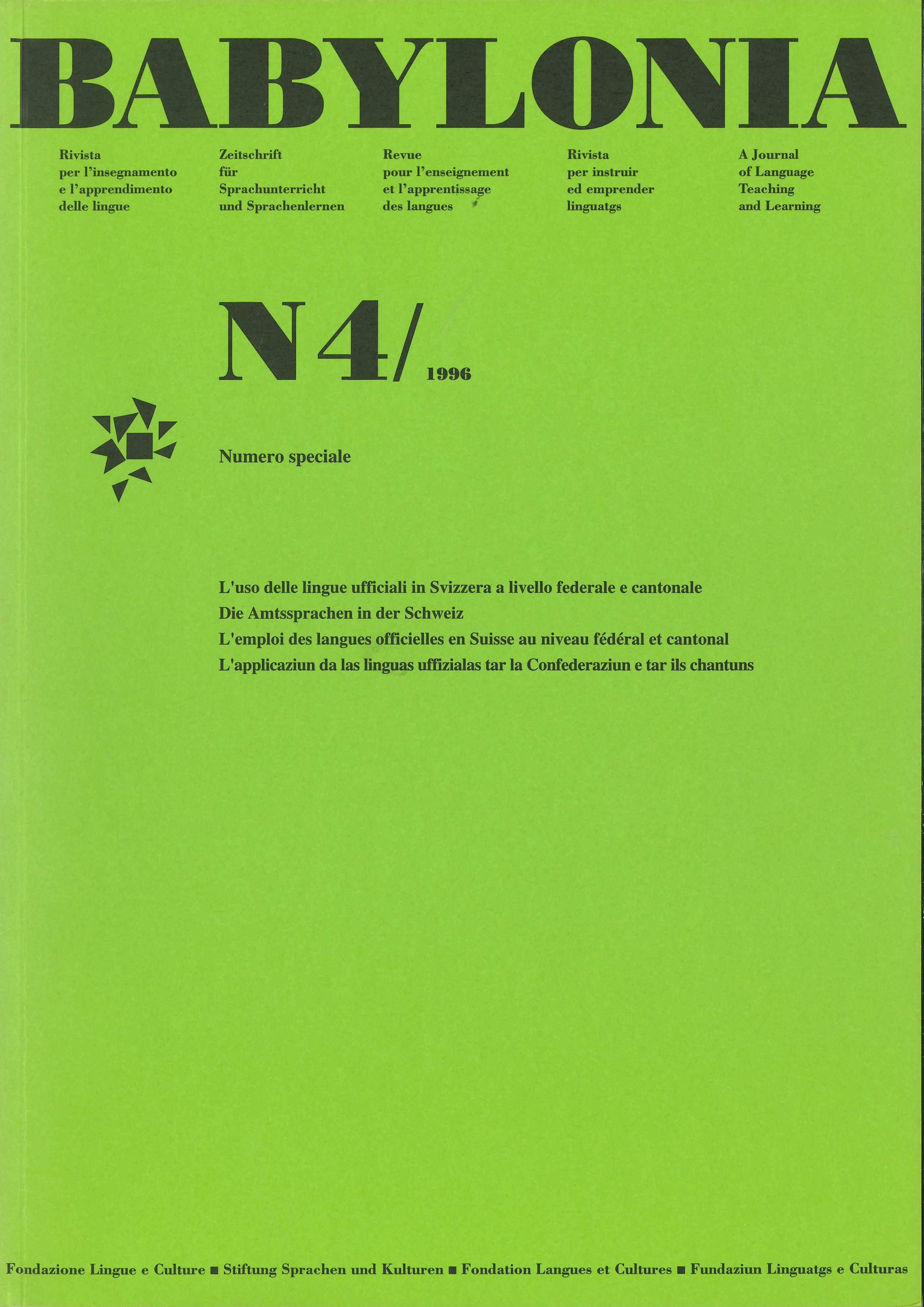
The use of official languages in Switzerland at federal and cantonal level
DOI:
https://doi.org/10.55393/babylonia.v4i.592Keywords:
PDF, 4_1996Abstract
[Summary generated by Poe]
The 4/96 issue of Babylonia presents the proceedings of the V meeting in Ascona focused on multilingualism, held from October 10 to 12, 1996. It emphasizes the significance of official languages in Switzerland and their application within federal and cantonal frameworks.
Key Contributions:
- Language and State: Government actions are viewed as linguistic acts crucial for social cohesion. Effective governance relies on clear communication.
- Language Policy: Iwar Werlen discusses the necessary transition from protecting languages to actively promoting their use, advocating for a proactive approach to multilingualism.
- Language Law: Martin Philipp Wyss analyzes the revised Article 116 of the Swiss Constitution, which underscores the need for equality among official languages, ensuring fair treatment in public administration.
- Italian in Administration: Urs Albrecht explores opportunities to enhance the use of Italian within federal administration, aiming to balance the linguistic landscape in Switzerland.
- Disparities Among Languages: Alfredo Snozzi examines the inequalities faced by Italian compared to German and French, highlighting systemic issues in various sectors.
- Personnel Policy: Sonia Weil discusses the impact of language issues on personnel policies, revealing how language barriers can hinder effective communication and collaboration among employees.
- Canton of Bern: Michel Schwob analyzes the complexities of bilingualism in Bern, emphasizing the need for tailored language strategies.
- Canton Fribourg: Kurt Estermann describes current linguistic practices and their alignment with policy objectives in Fribourg.
- Canton Grisons: Christian Brosi examines the multilingual dynamics in the Grisons region, where various languages coexist and interact.
- Canton Ticino: Gianpiero Gianella focuses on the status of Italian in Ticino, discussing its cultural significance and the challenges it faces in a predominantly German-speaking context.
- Bilingualism in Valais: Henri v. Roten analyzes how language influences identity and community relations in Valais.
- Comparative Analysis with Finland: Isolde Burr compares Switzerland’s language regulations with those in Finland and the historical context of the Austro-Hungarian Empire, offering lessons for improvement.
Conclusion: The issue highlights the need for a coherent language policy in Switzerland that actively promotes multilingualism and fosters integration among diverse linguistic communities.
Downloads
Published
1996-12-01
How to Cite
The use of official languages in Switzerland at federal and cantonal level. (1996). Babylonia Journal of Language Education, 4. https://doi.org/10.55393/babylonia.v4i.592
Issue
Section
Full issue