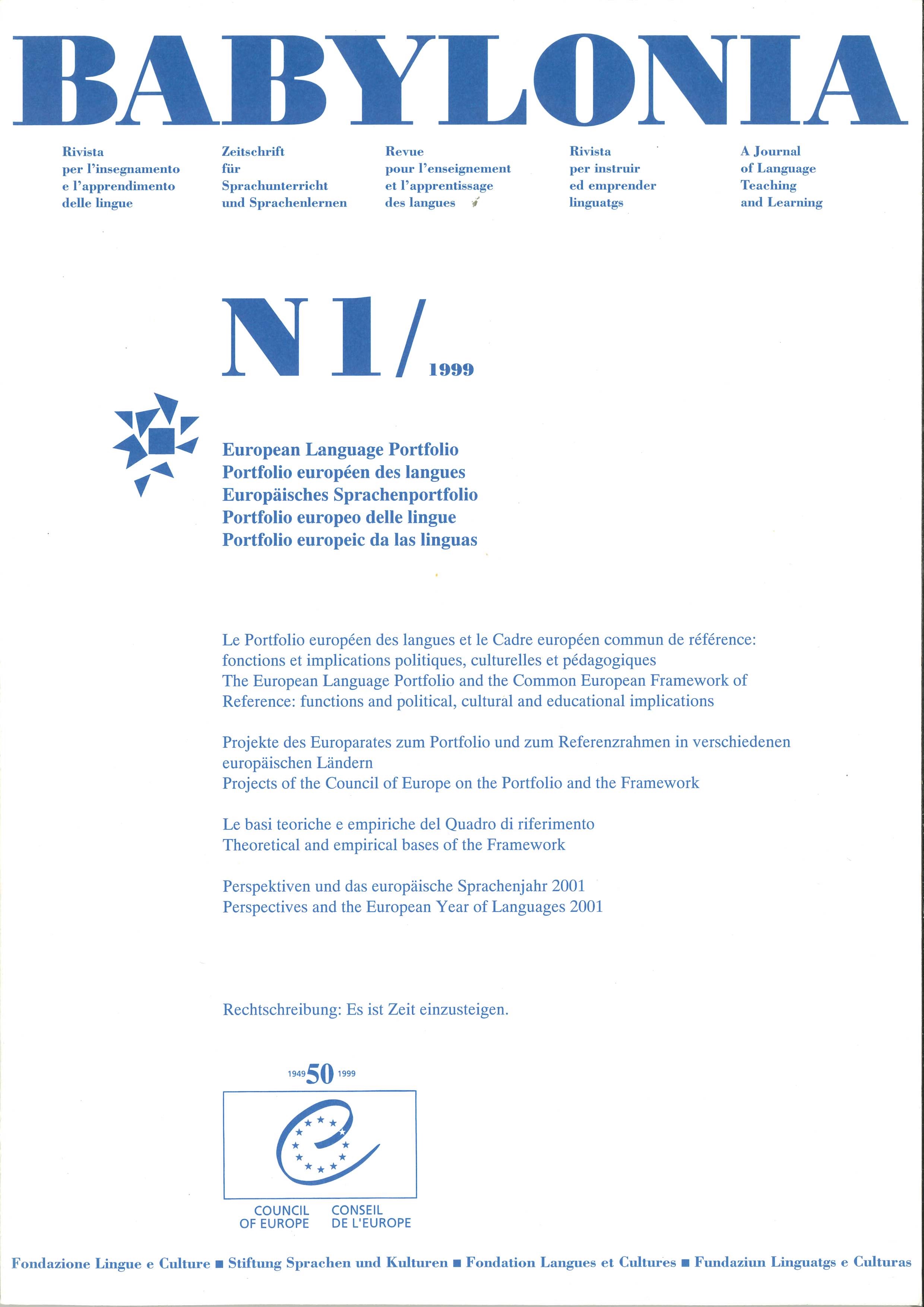
European Language Portfolio
DOI:
https://doi.org/10.55393/babylonia.v1i.621Keywords:
PDF, 1/1999Abstract
[Summary generated by ChatGPT]
Overview:
This issue of Babylonia focuses on the European Language Portfolio (ELP) as a tool for fostering democratic citizenship, multilingualism, and intercultural understanding in Europe. Developed by the Council of Europe, the ELP promotes language learning throughout life and values linguistic diversity.
Key Contributions:
Editorial Insights:
The editorial reflects on the Balkan crisis as a reminder of the importance of intercultural dialogue. It emphasizes the role of language education in building peace and democratic citizenship, aligning with the goals of the Council of Europe.
European Language Portfolio and Citizenship:
Joe Sheils outlines the ELP’s aim to support lifelong language and intercultural learning, enhancing communication across cultures and promoting democratic participation.
Linguistic and Cultural Diversity:
John Trim discusses the Common European Framework and the ELP as instruments for promoting multilingualism, warning against overreliance on English, which can hinder appreciation of Europe’s cultural richness.
Structure and Function of the ELP:
Ingeborg Christ presents the ELP’s three components: Language Passport, Language Biography, and Dossier. These help learners track and reflect on their language skills and experiences.
Challenges and Practical Considerations:
Alan Dobson examines the balance between uniformity and flexibility in designing portfolios suitable for different age groups and educational contexts.
Swiss Language Policy:
Cornelia Oertle Bürki describes Switzerland’s role in piloting the ELP and its alignment with national language policy, emphasizing multilingualism and inter-cantonal mobility.
Conclusion:
The ELP is portrayed as a transformative educational tool that supports inclusive, transparent, and intercultural language learning. Its implementation encourages responsible citizenship and enhances mobility within a multilingual Europe.
Downloads
Published
How to Cite
Issue
Section