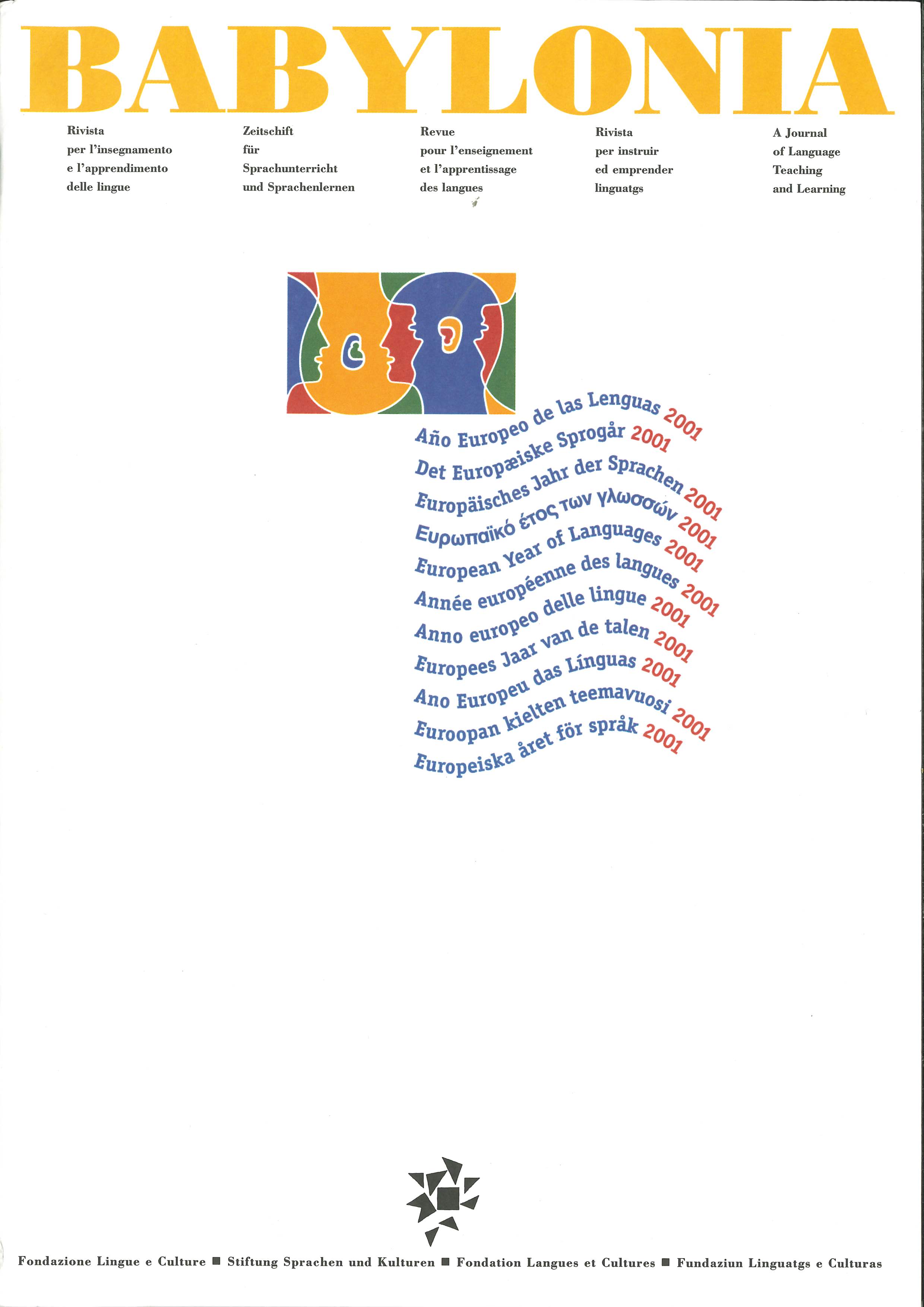
European Year of Languages
DOI:
https://doi.org/10.55393/babylonia.v1i.656Keywords:
PDF, 1/2001Abstract
[Summary generated by ChatGPT]
Overview:
This special issue celebrates the European Year of Languages 2001, focusing on multilingualism as both a lived reality in Switzerland and a broader European aspiration. It highlights language as cultural heritage, communication tool, and political issue.
Key Contributions:
Editorial Insights:
The editors emphasize Switzerland’s opportunity to promote linguistic diversity despite lacking the large-scale structures seen in other European countries. The issue presents local initiatives and encourages public engagement with language learning and appreciation.
Political and Social Reflections:
Federal Councillor Ruth Dreifuss and Hans Ulrich Stöckling (President of the Conference of Cantonal Education Directors) underline the importance of safeguarding linguistic plurality through new language policies and inclusive education reforms.
European Perspective:
Joe Sheils from the Council of Europe introduces the European Year of Languages, framing it as a campaign to celebrate linguistic diversity, promote individual multilingualism, and counter marginalization through language access.
Multilingualism and Identity:
Marcel Schwander reflects on historical and contemporary tensions between language communities in Switzerland. He urges readers to view multilingualism as a bridge, not a barrier, in shaping national cohesion.
Cultural Observations:
Chasper Pult shares insights from his work at the Swiss Cultural Centre in Milan. He emphasizes the importance of linguistic visibility in public cultural life and critiques Italy’s lack of interest in Switzerland’s multilingual identity.
Linguistic Autobiographies:
Personal stories from students and educators reflect the complex, often emotional journeys of language acquisition in a multilingual environment. These narratives humanize language learning as a lifelong and identity-shaping experience.
Creative Contributions:
Literary excerpts, such as Sylviane Roche’s piece on Spanish and emotional memory, add depth to the exploration of how language intertwines with personal and cultural identity.
Conclusion:
This issue encourages a renewed appreciation of language learning and diversity in Switzerland and Europe. It invites individuals, schools, and institutions to view language not merely as a skill, but as a vital force in shaping inclusive, interconnected societies.
Downloads
Published
How to Cite
Issue
Section