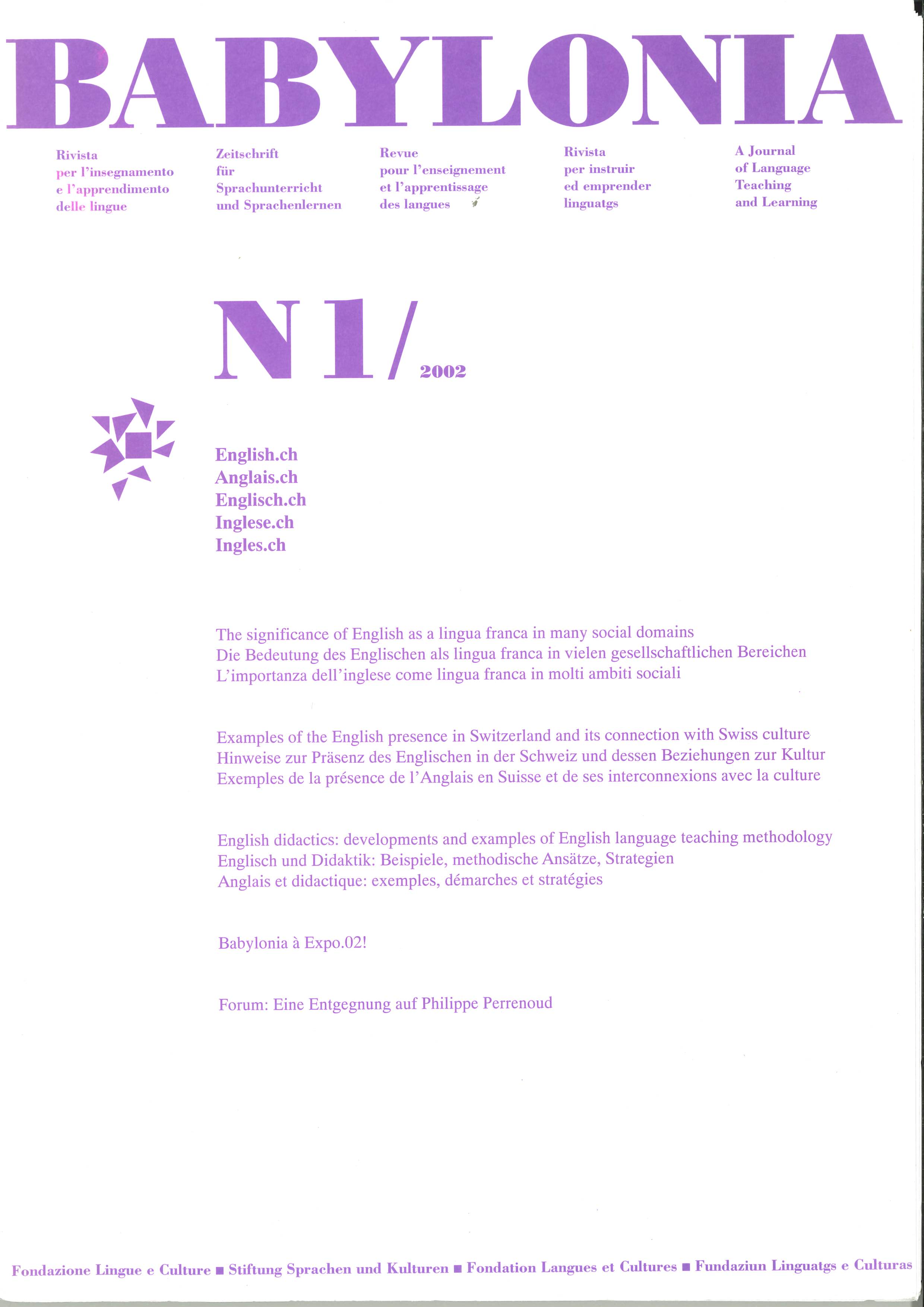
The significance of English as a lingua franca in many social domains
DOI:
https://doi.org/10.55393/babylonia.v1i.605Keywords:
PDF, 1_2002Abstract
[Summary generated by Poe]
The issue of "Babylonia" explores the growing influence of the English language in Switzerland, highlighting its role as a lingua franca due to globalization. Key contributions discuss the necessity of English in compulsory education, the challenges of its integration with national languages, and its impact on Swiss identity.
- Martine Brunschwig Graf and Carlo Schmid-Sutter debate the introduction of English in primary education, advocating for early language acquisition while cautioning against neglecting national languages.
- David Crystal analyzes the global status of English, attributing its dominance to historical political and economic factors rather than the number of native speakers.
- Ulla Kleinberger Günther emphasizes the significance of English in vocational education, arguing that it is essential for economic competitiveness.
- Albin Reichlin outlines how English is integrated into various professional training programs.
- Ruth Benvegnen notes the increasing demand for English courses among Swiss parents, driven by the perception that English is crucial for their children's futures.
The issue also discusses teaching methodologies, such as the Lexical Approach for vocabulary acquisition and the use of WebQuests as a tool for task-based learning, promoting engagement with authentic materials.
Downloads
Published
2002-04-04
How to Cite
The significance of English as a lingua franca in many social domains. (2002). Babylonia Journal of Language Education, 1. https://doi.org/10.55393/babylonia.v1i.605
Issue
Section
Full issue