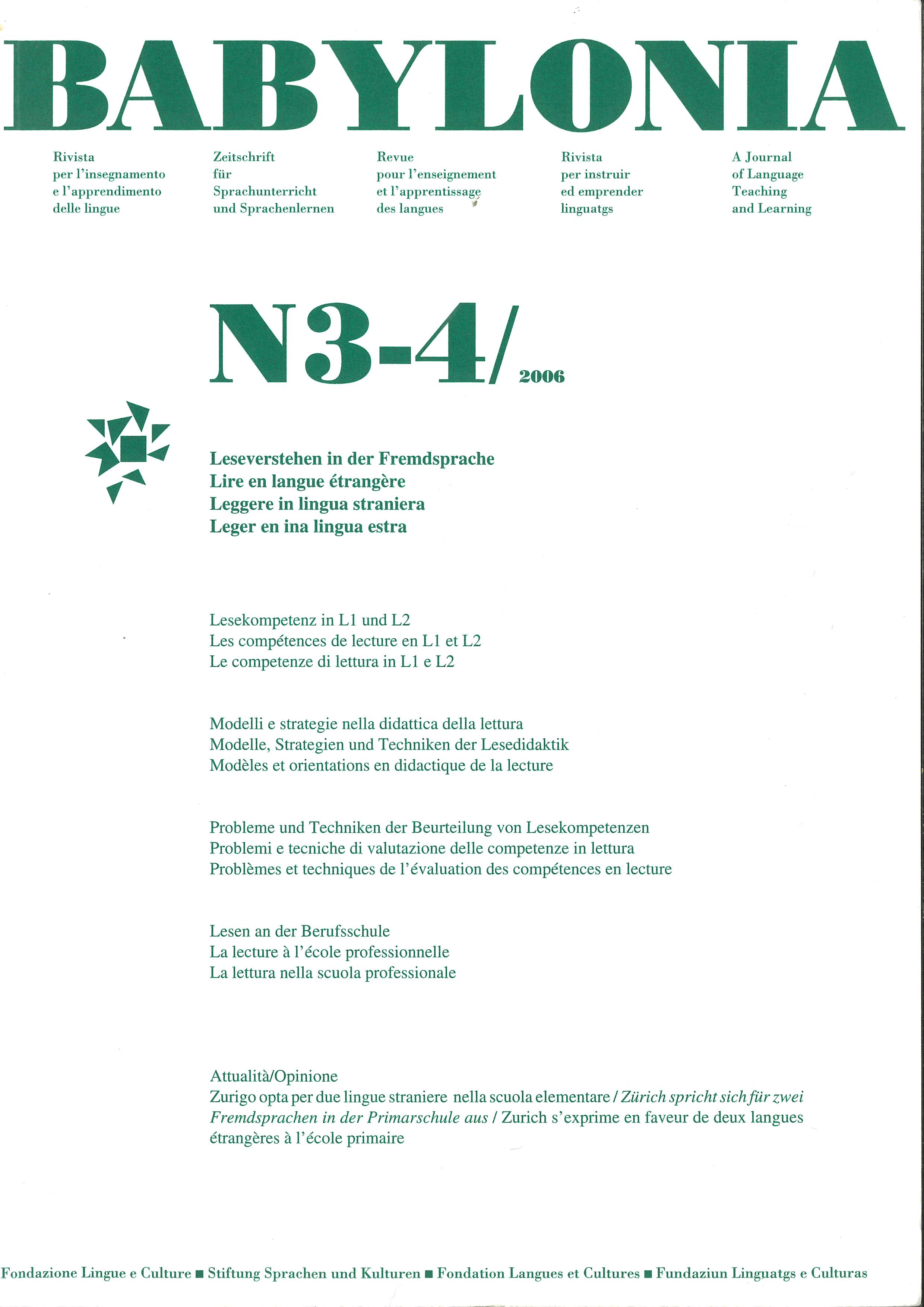
Reading in a foreign language
DOI:
https://doi.org/10.55393/babylonia.v3i.643Keywords:
PDF, 3_2006Abstract
[Summary generated by Poe]
The issue of Babylonia 3-4/06 focuses on reading comprehension in foreign languages, emphasizing its importance in multilingual education. It features contributions from various authors discussing theoretical frameworks, practical applications, and empirical studies related to reading skills across different languages.
Key Themes- Reading Comprehension as a Core Competence:
- Reading is presented as a complex skill essential for academic success. Authors stress the need for effective teaching strategies that integrate reading with other linguistic competencies.
- The issue introduces the concept of intercomprehension, where learners leverage their knowledge of related languages to enhance understanding. This approach is particularly relevant for Romance languages and highlights the cognitive processes involved in reading.
- Several articles delve into the cognitive mechanisms behind reading, such as phonological awareness and the role of background knowledge. Metacognitive strategies that help learners monitor and evaluate their understanding are also emphasized.
- The relationship between first language (L1) literacy and second language (L2) reading is explored. Proficient readers in their native language often struggle with L2 due to limited vocabulary and different syntactic structures.
- Contributions include practical recommendations for educators, such as using cooperative reading exercises, activating prior knowledge, and incorporating various text types to engage students.
- A section addresses the specific reading difficulties faced by vocational students, underscoring the importance of tailored materials and teaching methods to improve literacy in professional contexts.
- The issue includes findings from research that demonstrate the effectiveness of specific reading strategies and the role of interest in enhancing comprehension skills. These studies suggest that students benefit from explicit instruction in both cognitive and metacognitive strategies.
The Babylonia 3-4/06 issue highlights the multifaceted nature of reading comprehension within multilingual education. It advocates for integrated teaching approaches that consider cognitive processes, the influence of L1 on L2 learning, and the necessity of developing robust reading strategies. The contributions collectively emphasize that fostering reading skills is crucial for academic achievement and effective participation in a globalized world.
Downloads
Published
How to Cite
Issue
Section