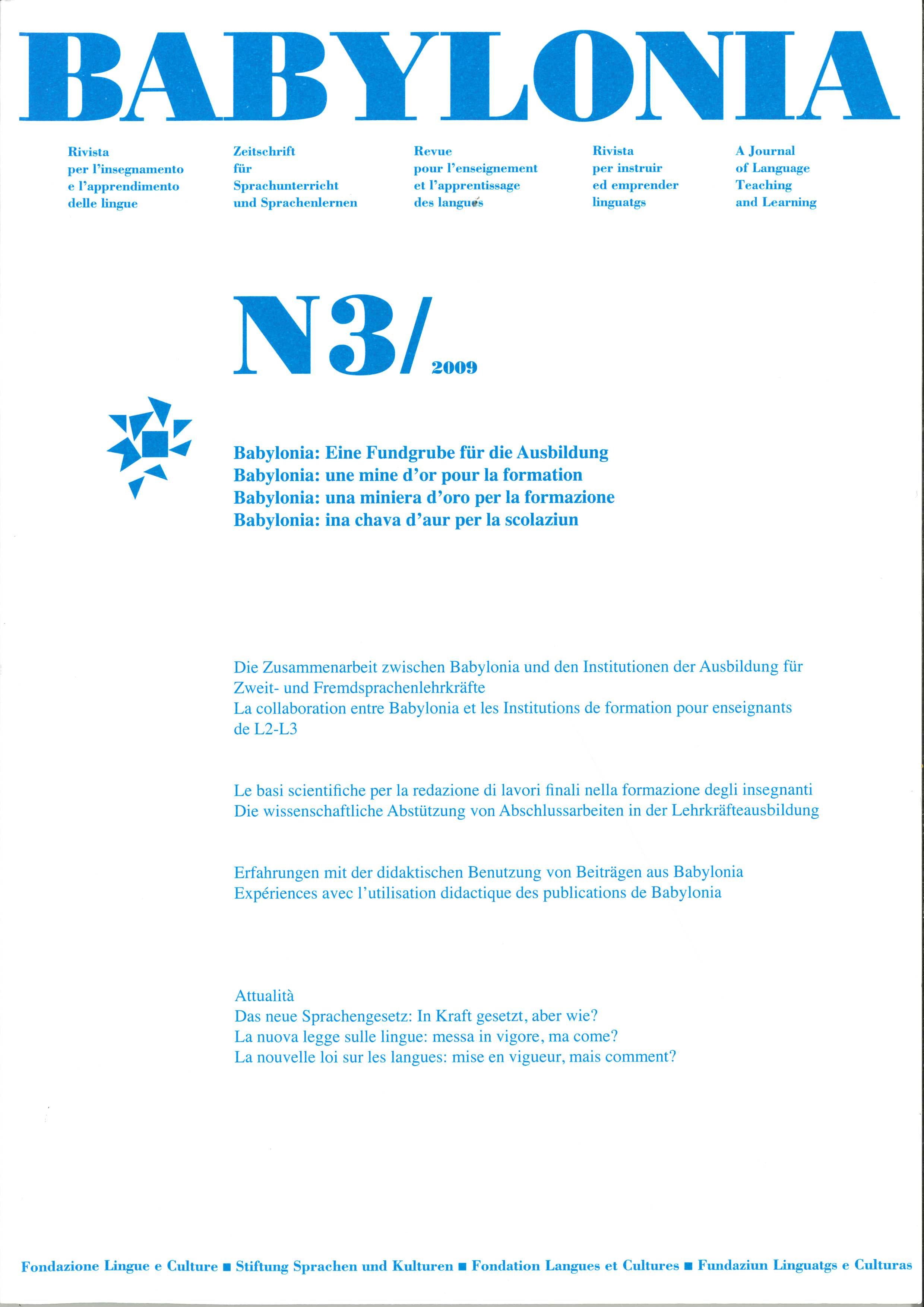
Babylonia: a gold mine for training
DOI:
https://doi.org/10.55393/babylonia.v3i.691Keywords:
PDF, 3/2009Abstract
[Summary generated by ChatGPT]
Overview
Issue 3/2009 of Babylonia is dedicated to the theme of Integrated Language Didactics (ID), exploring its significance and implementation across Switzerland’s multilingual educational landscape. It reflects on both the conceptual foundations and practical applications of ID, emphasizing how a more coherent and inclusive approach to language teaching can respond to sociolinguistic and educational challenges.
Key Contributions
- Editorial Framing: The issue opens by highlighting a recent controversy surrounding the dominance of dialects in German-speaking Switzerland, especially in school settings, and how this raises broader questions about the place of standard languages and multilingualism in education.
- Language Legislation: The 2009 federal law on languages is recognized as a turning point, giving the Swiss Confederation a more active role in promoting multilingualism.
- Conceptual Development: Articles trace the evolution of integrated didactics from early political declarations (e.g., Gesamtsprachenkonzept) to its increasing institutional recognition, with emphasis on cross-linguistic synergies and learner-centered approaches.
- CIIP Forums: The issue documents contributions from two major events: the FLECH Forum and the 4th Forum of the CIIP, both focused on exploring how ID can bridge local, foreign, and heritage languages in teaching.
- Regional Differences: Several articles compare the varying conceptualizations and implementations of ID in the French- and German-speaking regions. While the German-speaking part leans toward inclusive integration across all language domains, the French-speaking side tends to maintain clearer distinctions between teaching the local language and foreign languages.
- Practice-Oriented Contributions: Articles present didactic strategies, tools, and classroom experiences. For example, the adaptation of new teaching materials (like Explorers and Mille feuilles) is discussed as evidence of ID in practice.
Conclusion
This issue argues that integrated language didactics must not aim for rigid uniformity but rather embrace the complementarity of different approaches. It suggests that multilingual classrooms and diverse learner profiles call for flexible pedagogies that make connections between students’ various linguistic resources. The collected contributions reflect both theoretical consensus and practical divergence, showing that ID is as much about political commitment and cultural awareness as it is about teaching methodology. Ultimately, the issue positions Babylonia as both an observer and a driver of this ongoing pedagogical transformation.
Downloads
Published
How to Cite
Issue
Section