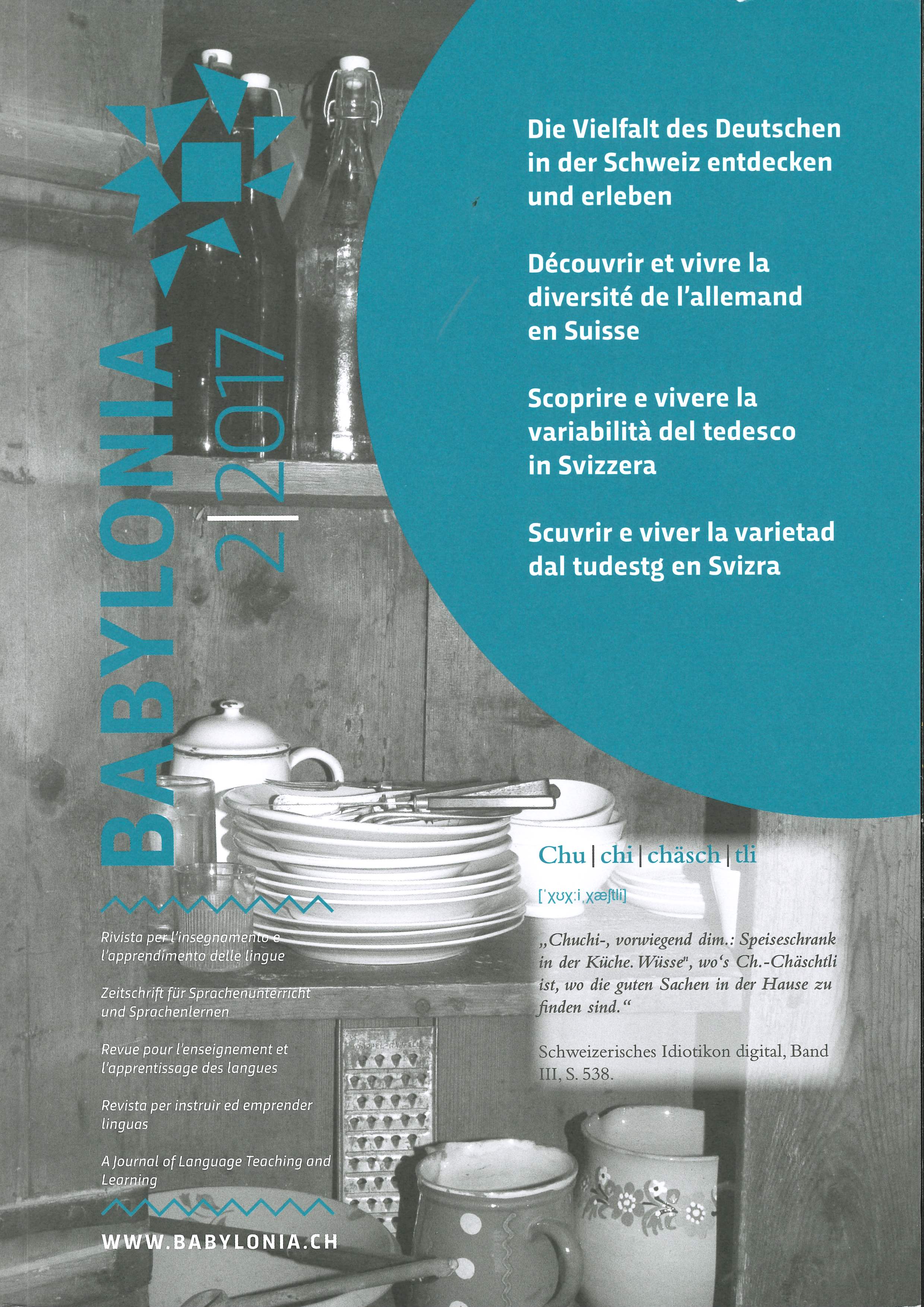
Discover and experience the diversity of German in Switzerland
DOI:
https://doi.org/10.55393/babylonia.v2i.695Keywords:
PDF, 2/2017Abstract
[Summary generated by ChatGPT]
This issue of Babylonia 2/2017 is dedicated to the topic of language learning and plurilingualism in vocational education and training (VET), a domain that often receives less attention than general education but holds substantial societal and economic significance. In the context of global mobility, the increasing diversity of learners, and evolving labor market demands, the role of languages in vocational training is undergoing profound changes. The issue brings together diverse contributions from Switzerland and beyond, offering both theoretical insights and practical projects.
Key themes include:
-
Integration of plurilingualism in vocational training curricula: Several articles explore how training programs, especially in bilingual regions, are beginning to include language awareness and practical language skills in workplace settings.
-
Language-sensitive teaching in VET: Authors highlight the importance of teachers and trainers being aware of linguistic diversity and the challenges faced by learners with different linguistic backgrounds, especially migrants and second-language learners.
-
Transversal competences: The issue discusses how language competences are closely tied to other key skills such as communication, interculturality, and professional identity development.
-
Research and innovation: Empirical studies and action-research projects, particularly in the French-speaking and Italian-speaking regions of Switzerland, illustrate innovative approaches to language support in apprenticeship models.
-
Policy and institutional support: Some contributions examine how institutional and policy frameworks can better promote linguistic inclusion in vocational settings.
Notable contributions:
-
A study by Gajo, Duchêne & Lörtscher presents a theoretical framework for understanding plurilingual practices in VET.
-
The project “L’intégration des langues dans la formation professionnelle” coordinated by the HEP Vaud and ECAL highlights the use of translanguaging and scaffolded learning in design and technical domains.
-
The Italian-speaking section introduces projects that foster multilingual professional environments, such as training for restaurant staff using flexible language modules.
-
Case studies from German-speaking Switzerland show how apprentices with migration backgrounds manage multiple linguistic demands in their training paths.
This issue encourages educators, researchers, and policymakers to rethink how language education can be embedded meaningfully within vocational contexts. It advocates for a systemic recognition of linguistic diversity as a resource rather than an obstacle, supporting inclusive and future-ready education systems.
Downloads
Published
How to Cite
Issue
Section