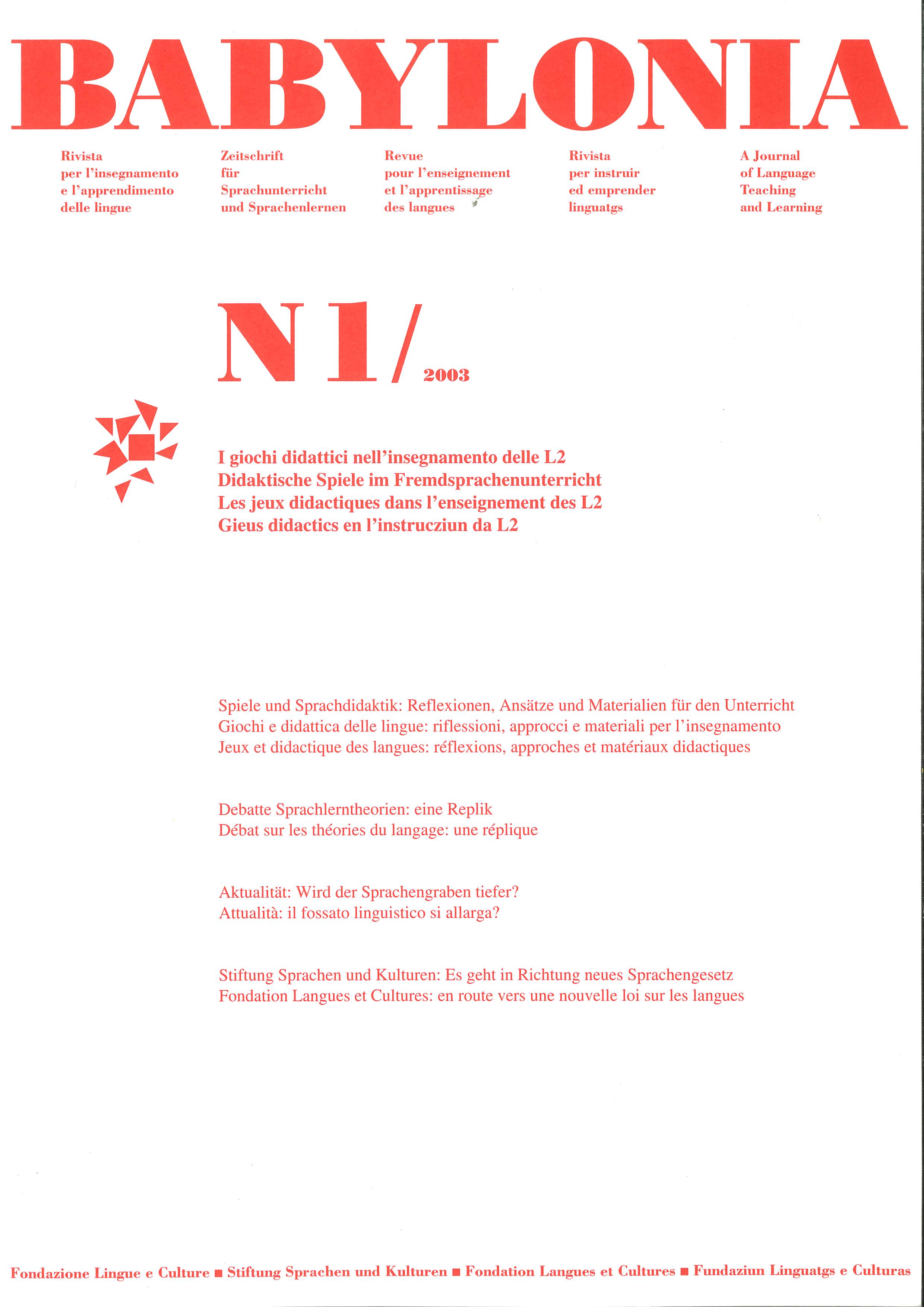
Educational games in L2 teaching
DOI:
https://doi.org/10.55393/babylonia.v1i.664Keywords:
PDF, 1/2003Abstract
Overview:
This issue of Babylonia focuses on didactic games in second language (L2) teaching, exploring their potential to promote creativity, motivation, and engagement in language learning. It argues that games can bring authenticity and joy to the classroom while fostering meaningful communication and language acquisition.
Key Contributions:
The editorial frames games as powerful tools for both children and adults, helping overcome resistance to learning through play. Several contributors examine the pedagogical value of games, including Michael Koenig, who advocates for creative redesign of traditional exercises to promote learner autonomy and deeper interaction.
Contributions range from philosophical reflections to classroom-based examples. Articles explore how early playful language learning reduces psychological distance from the target language, how rules and rituals in games support social and linguistic development, and how games integrate real-world language use and intercultural competence.
Case studies include memory games, dramatizations, storytelling, and interdisciplinary projects. A special section examines how school textbooks incorporate (or fail to incorporate) meaningful game-based activities. Other pieces suggest methods for students to co-design games, enhancing both motivation and ownership of learning.
Conclusion:
Babylonia 1/2003 champions the use of didactic games not as superficial diversions but as central tools for effective language teaching. The issue encourages teachers to be creative, reflective, and flexible—redesigning exercises to maximize learning, interaction, and enjoyment.
Downloads
Published
How to Cite
Issue
Section