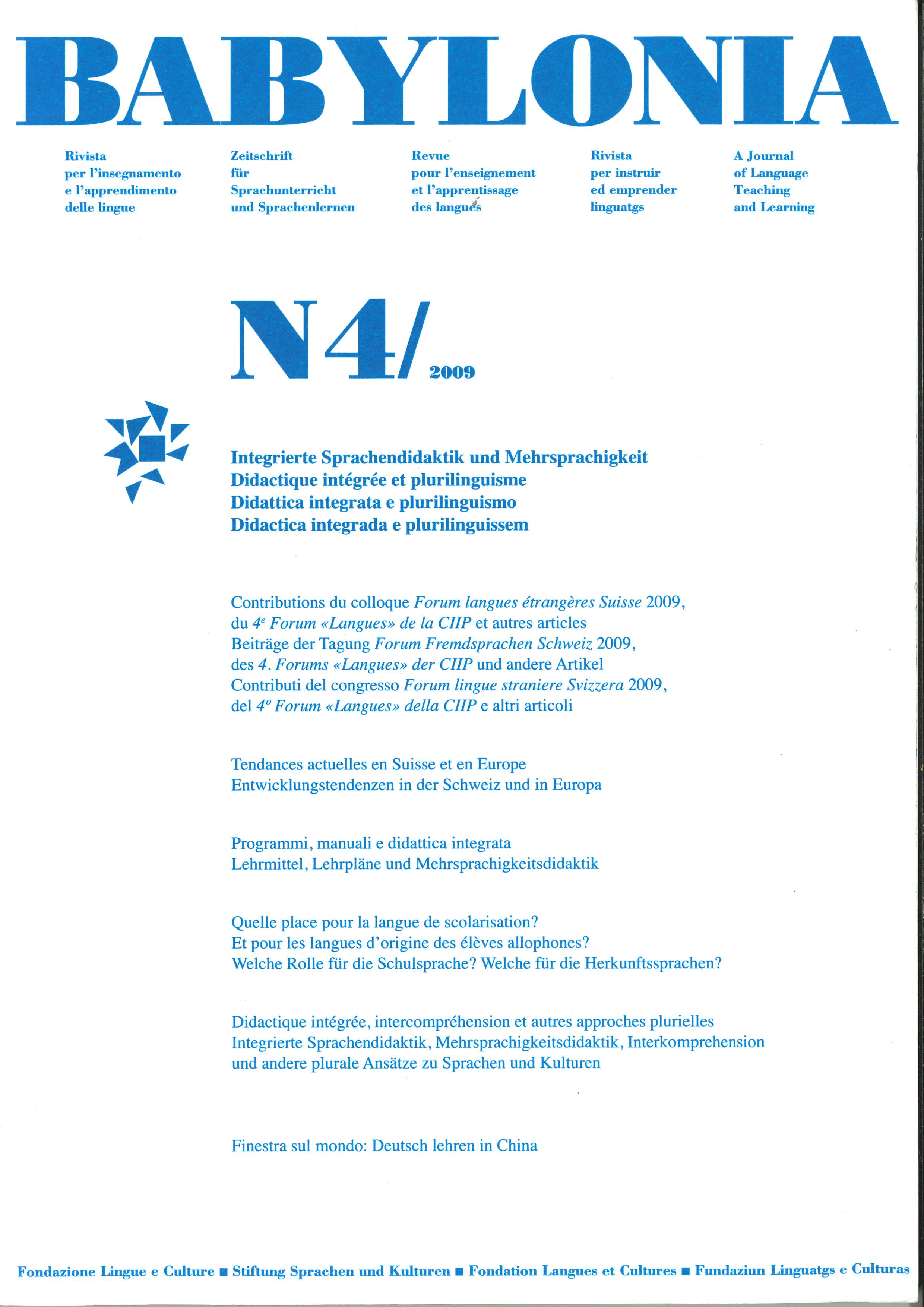
Integrated language teaching and multilingualism
DOI:
https://doi.org/10.55393/babylonia.v4i.677Keywords:
PDF, 4/2009Abstract
[Summary generated by ChatGPT]
Overview:
This issue of Babylonia focuses on Integrated Language Didactics (ILD), a pedagogical approach aimed at creating coherence across language learning in schools. It reflects ongoing efforts in Switzerland to overcome the fragmentation of language instruction and respond to the multilingual reality of learners. The issue brings together contributions from two key events: the FLECH Forum and the 4th CIIP Forum, offering cross-regional perspectives from French- and German-speaking Switzerland.
Key Contributions:
The editorial opens with a reflection on Switzerland’s linguistic contradictions: despite a new national language law and political attention to multilingualism, dialects often dominate public space, particularly in German-speaking regions. This tension underlines the need for a clear and inclusive approach to language teaching.
ILD is presented as a response to this challenge. It promotes the coordination of teaching across L1 (local school languages), L2 (foreign languages), classical languages, and migrant languages, encouraging synergies rather than parallel curricula. However, the editorial also notes resistance, misunderstandings, and different interpretations of ILD across linguistic regions.
The first part of the issue includes articles from the FLECH Forum, focusing mainly on the relationship between second and third language teaching and new materials like Explorers, envol, and Young World. Authors such as G. Manno, C. Brohy, and C. Le Pape explore how learners’ prior linguistic knowledge can be activated across languages.
The second part includes contributions from the CIIP Forum, which emphasizes ILD within the teaching of French as a school language. Contributions by D. Coste and Ch. Merkelbach link ILD to the Plan d’Études Romand, while J.-F. de Pietro, A. Kolde, C. Balsiger, and Ch. Perregaux examine how ILD applies to old languages, teacher training, and local curricula.
The issue ends with S. Melo’s research on intercomprehension and collaborative writing, highlighting innovative strategies that bring multiple languages into an integrative pedagogical view.
Conclusion:
Babylonia 3/2010 illustrates both the promise and complexity of integrated language didactics in a multilingual democracy. Rather than imposing a uniform model, it showcases diverse approaches and encourages dialogue between linguistic regions and didactic traditions. The issue calls for sustained reflection, collaboration, and policy commitment to make ILD a reality in everyday classrooms.
Downloads
Published
How to Cite
Issue
Section