Bd. 1 (2022): Wortschatz und Digitalisierung

					Ansehen Bd. 1 (2022): Wortschatz und Digitalisierung
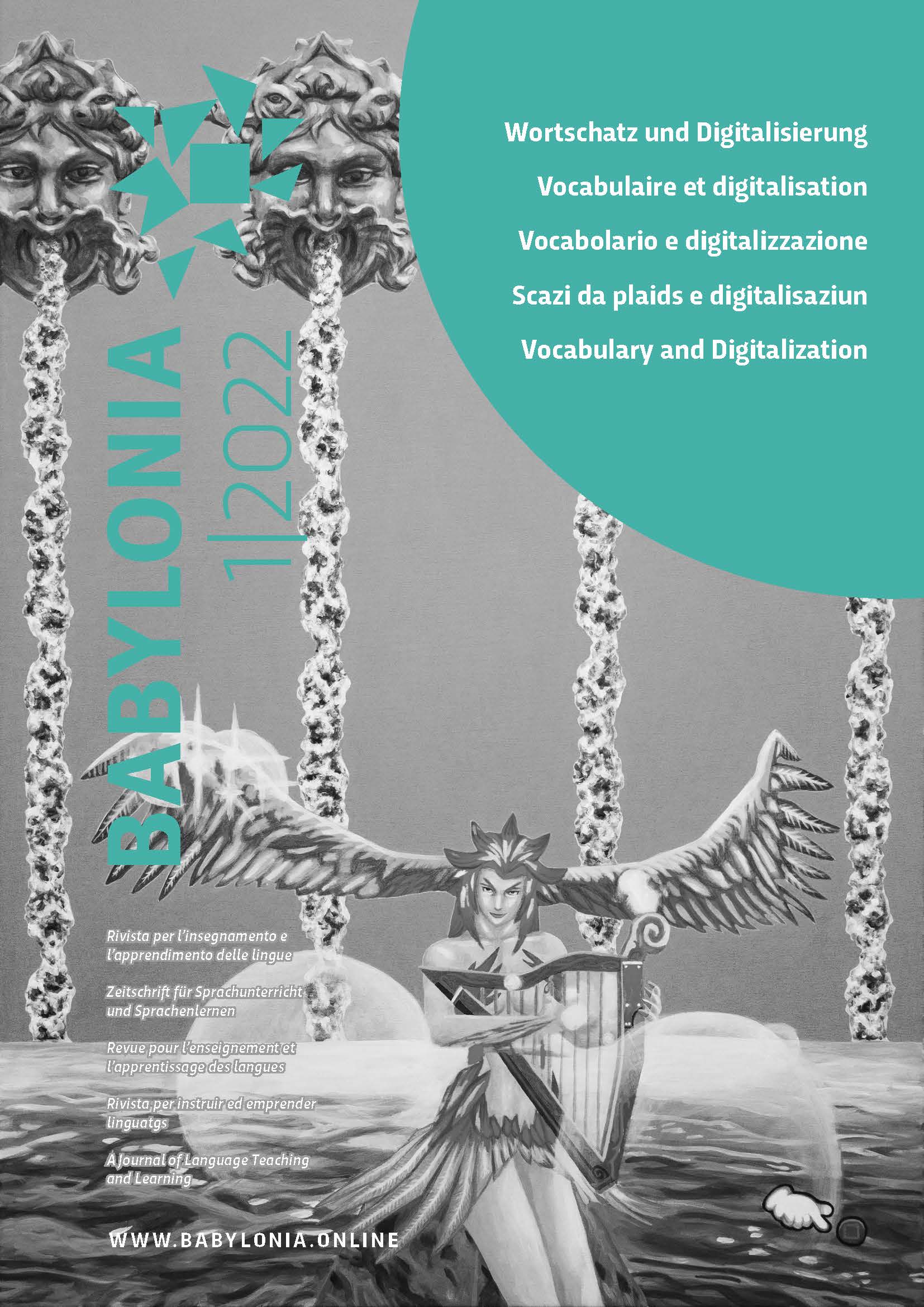
Responsabili di redazione per il tema:
Verantwortliche für den thematischen Teil:
Responsables de rédaction pour le thème:
Responsabels per la part tematica:

Laura Loder Buechel, Elisabeth Peyer & Isabelle Udry

Print on demand

Hören Sie sich das Interview des CeDiLE mit den Herausgeberinnen dieser Ausgabe an: [Podcast]

Mehr zu diesem Thema von unserem Partner, dem CeDiLE: [Interview], [Podcast], [Table ronde]

Veröffentlicht: 2022-04-26

Komplette Ausgabe

  • Vocabulary and Digitalization

    DOI: https://doi.org/10.55393/babylonia.v1i.204

Editorial

  • Editorial

    Redaktion von Babylonia
    6-7
    DOI: https://doi.org/10.55393/babylonia.v1i.206

Introduzione

  • Wortschatzlernen mit digitalen Medien: Many tools, many uses

    Isabelle Udry, Elisabeth Peyer, Laura Loder Buechel
    8-10
    DOI: https://doi.org/10.55393/babylonia.v1i.205

Intervista

  • Digitale Ressourcen für das Wortschatzlernen auswählen 3 Fragen an Dr. Susanne Krauß

    Redaktion von Babylonia
    12-13
    DOI: https://doi.org/10.55393/babylonia.v1i.173

Tema

  • Young gamers in the digital wilds Implications of gaming preferences on L2 English vocabulary learning and teaching

    Pia Sundqvist, Rickard Nilsson
    14-19
    DOI: https://doi.org/10.55393/babylonia.v1i.153
  • Promouvoir l’interaction dans une salle de classe avec la réalité virtuelle et l’intelligence artificielle

    Carlos Pestana, Rachel Koller
    20-24
    DOI: https://doi.org/10.55393/babylonia.v1i.150
  • The Boy in the Dress: Digital Ways of Teaching Identity-Related Vocabulary in Sek-I Classrooms

    Gustav Arnold, Irene Althaus, Marie-Nicole Bossart, Katharina Fischer, Simone Ries
    26-31
    DOI: https://doi.org/10.55393/babylonia.v1i.154
  • Überzeugungen von Lernenden der Sekundarstufe I zur Nützlichkeit der Übersetzungstools DeepL und LEO für die Wortschatzarbeit im Fremdsprachenunterricht

    Raphaël Perrin, Catherine Diederich, Sandrine Wild, Linda Grimm
    38-41
    DOI: https://doi.org/10.55393/babylonia.v1i.156
  • Übersetzungsmaschinen im Englischunterricht des Zyklus 3

    Meike Raaflaub, Brigitte Reber
    42-49
    DOI: https://doi.org/10.55393/babylonia.v1i.141
  • Synergieeffekte zwischen Online-Übersetzungen und Sprachmittlungsaufgaben zur Förderung der lexikalischen Kompetenz – Ein praktisches Beispiel für das Sprachenpaar Deutsch-Spanisch

    Melanie Arriagada
    50-55
    DOI: https://doi.org/10.55393/babylonia.v1i.151
  • Promoting Academic Vocabulary Learning through Screencast Feedback

    Holli Schauber
    56-59
    DOI: https://doi.org/10.55393/babylonia.v1i.157
  • Wortschatzaufbau durch virtuelle Lesecoachings

    Isabelle Udry, Sabine Kutzelmann
    60-65
    DOI: https://doi.org/10.55393/babylonia.v1i.148
  • Digitaler Wortschatzerwerb in Fachsprachenkursen

    Elisabeth Reiser-Bello Zago, Barbara Etterich
    66-71
    DOI: https://doi.org/10.55393/babylonia.v1i.146
  • Student teachers’ experiences with digital tools for vocabulary learning

    Susanna Schwab
    72-77
    DOI: https://doi.org/10.55393/babylonia.v1i.145
  • “So, I decided to focus on all the useful words with her first.” Student teachers in Zurich teaching online English lessons one-to-one to young learners in Bishkek, Kyrgyzstan with a focus on lexis.

    Esther Graf-Beglinger, Silvia Frank Schmid
    78-83
    DOI: https://doi.org/10.55393/babylonia.v1i.182

Finestra

  • Arsène Lupin au menu de l’enseignement du FLE : quelques pistes didactiques

    Audrey Freytag-Lauer, Gaëlle Burg, Carine Greminger Schibli, Lilli Papaloïzos
    84-90
    DOI: https://doi.org/10.55393/babylonia.v1i.197